LILING LIU
AI & Automation Engineer | Senior Technical Artist
Building AI tools, automation workflows, technical pipelines, and
real-time production solutions across Art, Engineering, and AI.

AI Image & Video Generation System
Multi-model generation, virtual character workflows, project-based usage tracking, cost analysis, and feedback-driven prompt optimization.
AI & Automation Engineer
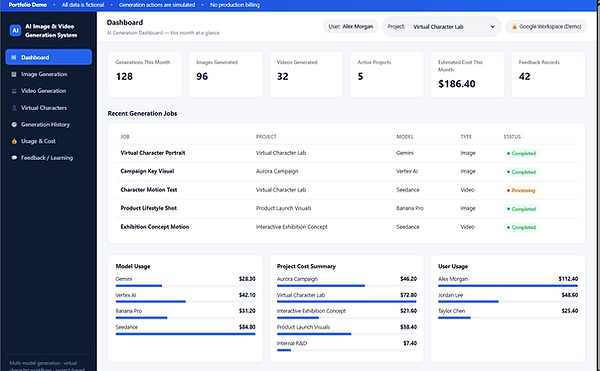
Designed and developed a multi-model AI generation platform integrating image and video generation, virtual character workflows, multimodal references, project/user usage tracking, cost analytics, and feedback-driven prompt refinement.
#Multi-model AI · #Virtual Characters · #Multimodal Workflow · #Cost Analytics · #Prompt Optimization
Portfolio Reconstruction · Fictional data · Proprietary details omitted
01 — Overview
AI Image & Video Generation System is an internal AI production platform designed to unify multi-model image and video generation, virtual character workflows, multimodal reference inputs, project/user attribution, cost tracking, and feedback-driven prompt optimization.
Rather than functioning as a standalone generation interface, the system connects generation jobs to authenticated users, selected projects, model usage, cost records, character profiles, generation history, and feedback workflows—making AI generation measurable and manageable within a production environment.
Portfolio Reconstruction
Based on an internal production system I designed and developed. All users, projects, usage data, costs, generated content, and operational metrics shown are fictional. Proprietary production details and live integrations have been omitted.
02 — Problem
Fragmented AI Generation
Image and video generation were distributed across different models and workflows, making it difficult for users to choose the right tool and maintain a consistent production process.
User & Project Attribution
Generation activity needed to be associated with both the user and the project so usage could be traced across different workstations and production tasks.
Cost Visibility
API and generation costs varied significantly between models, image jobs, and video jobs, making project-level cost estimation difficult without centralized tracking.
Virtual Character Consistency
Virtual characters required structured identity data, reference assets, and character-specific constraints to maintain consistency across repeated image and video generation.
Feedback & Prompt Quality
One-off prompts did not capture what users liked or disliked about previous outputs, limiting the system's ability to improve future generations.
03 — My Role
Role: AI & Automation / Full-stack / Technical Solution Development
I worked across product and workflow planning, UI / UX design, front-end and back-end development, AI model integration, user/project attribution, virtual character workflow design, generation job processing, usage tracking, cost analysis, and feedback-driven prompt refinement.
Product / Solution
-
Product & Workflow Planning
-
UI / UX Design
-
Technical Feasibility
-
Multi-model Workflow Design
-
Virtual Character Workflow
-
Cost / Usage Evaluation
Engineering
-
Front-end Development
-
Back-end Development
-
AI / Model Integration
-
User / Project Attribution
-
Job Processing
-
Generation History
-
Feedback / Prompt Refinement
Designed the system as a production platform rather than a direct model interface, connecting generation, identity, project context, cost, history, and feedback into a reusable workflow.
04 — Platform Capabilities

Multi-model Image Generation
Supports multiple image-generation providers and model selection based on production needs, including Gemini, Vertex AI, Banana Pro, and model-routing / recommendation concepts.
Multimodal Video Generation
Supports Seedance-based text-to-video, image-to-video, and reference-based video workflows with image, video, and audio reference assets.
Virtual Character Workflow
Uses structured character profiles, tags, visual constraints, and reference sets to improve consistency across image and video generation.
User & Project Tracking
Associates every generation job with an authenticated user and selected project, allowing activity to remain traceable across workstations.
Usage & Cost Analytics
Tracks generation activity by project, user, model, and generation type to support cost estimation and production decision-making.
Feedback-driven Prompt Optimization
Stores user feedback and generation history to support prompt enhancement and future prompt refinement without claiming autonomous model retraining.
05 — Generation & Virtual Character Workflow

The generation workflow combines project context, user identity, model selection, reference assets, and structured virtual-character metadata before submitting a generation job.
Virtual characters can be referenced directly inside prompts using tags such as @Astra. The system resolves the character profile, associated reference assets, visual constraints, and generation context before sending the request to the selected model.

06 — System Architecture
The system separates user/project context, generation workflows, model integration, character metadata, usage tracking, and feedback records into independent responsibilities so models and production workflows can evolve without rebuilding the entire platform.

07 — Technical Decisions & Trade-offs

Multi-model vs. Single-provider Integration
Decision: Support multiple generation models instead of hard-coding the workflow to a single provider.
Why: Different models offer different trade-offs in quality, speed, capabilities, cost, and production fit.
Generation Tool vs. Production Platform
Decision: Attach every generation job to user, project, model, and usage records.
Why: AI generation becomes operationally useful only when teams can trace who generated what, for which project, using which model, and at what cost.
Generic Prompting vs. Structured Character Context
Decision: Use structured character profiles, tags, visual constraints, and references.
Why: Repeatedly rewriting character descriptions in prompts is inefficient and produces inconsistent identity across generations.
Creative Flexibility vs. Cost Visibility
Decision: Track usage and cost at project, model, and user levels.
Why: Higher-quality or video models may produce better results but can significantly increase production cost.
Autonomous Learning vs. Controlled Prompt Refinement
Decision: Use stored feedback to refine future prompts rather than claiming autonomous model retraining.
Why: Prompt refinement improves output quality while keeping the system understandable, controllable, and production-safe.
08 — Impact
Unified AI Production Workflow
Unified image, video, character, project, and usage workflows into one production-oriented system.
Better Model Selection
Made model choice more explicit by exposing differences in generation type, capability, and cost.
Project-level Cost Visibility
Enabled AI usage to be translated into project, model, and user-level cost information for budgeting and pricing decisions.
Continuous Prompt Improvement
Turned user feedback and generation history into structured input for future prompt enhancement and refinement.
The project demonstrates how AI generation can be integrated into a measurable production system—connecting models, users, projects, virtual characters, cost, history, and feedback rather than treating generation as an isolated API call.